Google Forms response limits: how many responses can one form handle?
Last updated September 2026 · ~9 minute read
Short answer: Google does not publish a maximum. What it publishes is a set of thresholds where features stop working — the response summary above 50,000, syncing to Sheets above 100,000, CSV timestamp order and the question and individual views above 10,000. Google states that past these points “your form continues to receive responses, which you can download in a CSV file.” No hard cap on the number of responses is documented anywhere in Google's help pages. If you link responses to a spreadsheet, the real ceiling is a Sheets one: 10 million cells.
“Unlimited” is the answer you will find on most pages about this, and it is not something Google says. The accurate version is narrower and more useful: there is no published cap, there are four published degradation points, and there is a separate hard limit in Google Sheets that most high-volume forms hit long before anything in Forms itself misbehaves.
How we checked
Every number below is quoted from a Google help page, not from a blog or a forum thread. Two pages carry
all of it: “View & manage form responses” in the Google Docs Editors Help Centre
(support.google.com/docs/answer/139706), which has a section headed “Learn more about response
limits on Forms”, and “Files you can store in Google Drive”
(support.google.com/drive/answer/37603), which carries the Sheets size limits. Character-count
wording comes from “How to set rules for your form”
(support.google.com/docs/answer/3378864). Where Google publishes nothing, this page says so
rather than filling the gap with a plausible number.
The published limits
Google's framing matters as much as the numbers: “If certain features in your form don't work as expected, it might be because it has a large number of responses. These limits ensure Forms work reliably for all users. Your form continues to receive responses, which you can download in a CSV file.”
| Limit | Value | Published by Google / Not published |
|---|---|---|
| Maximum responses a form will accept | No number | Not published. No hard cap appears on any Google help page. |
| Response summary may stop displaying | Above 50,000 responses | Published — “View & manage form responses”. |
| Responses may stop syncing to Sheets | Above 100,000 responses | Published — same page. |
| CSV download may not be sorted by timestamp | Above 10,000 responses | Published — same page. |
| Question view and individual view may disappear | Above 10,000 responses | Published — same page. |
| Linked spreadsheet size | 10 million cells, or 18,278 columns | Published — Google Drive file-size limits. This is a cell limit, not a row limit. |
| Maximum characters in an answer | No number | Not published. Google documents only the character count you set as a validation rule. |
| Maximum questions and sections per form | 300 pieces of content · 75 sections | Published. Google states “you can add and edit up to 300 pieces of content, like questions, descriptions, images, and videos” and “you can add up to 75 sections” on its Edit your form page. Note that 300 counts blocks, so a 200-option dropdown consumes one of them, not 200. |
| Maximum options per question | No number | Not published. The 300-block ceiling above is the only related figure Google gives. |
| Submissions per second / rate limits | No number | Not published. |
| Total size of files collected by a file-upload question | No number | Not published. The setting exists; Google does not document its values. See our file upload guide. |
What actually breaks first
The thresholds do not arrive in the order you would expect. Sorted by when you will actually feel them:
1. At 10,000 — the views you use every day
Two things go at the same number. Google: “If you don't find the question or individual view for responses in Forms, it can be because your form has more than 10,000 responses.” And: “If you download your responses in a CSV file and the responses aren't sorted by the timestamp when users submit them, it can be because your form has more than 10,000 responses.”
This is the one that surprises people, because 10,000 is a realistic number for a school, a conference or a support form running for a year. Nothing is lost — but browsing responses one at a time inside Forms stops being an option, and a CSV you assumed was chronological may not be. If your workflow depends on “the most recent 50 responses”, sort the CSV by the timestamp column yourself rather than trusting the file order.
2. At 50,000 — the summary and its charts
Google: “If you don't find the response summary, it can be because your form has more than 50,000 responses.” The summary tab is where the pie charts and bar charts live, so past this point Forms stops being an analysis tool and becomes a collection endpoint. The data is intact and downloadable; the visualisation is what goes. Anyone who needs charts at this volume is doing them in Sheets, a BI tool, or a report exported before the form got this big.
3. At 100,000 — the Sheets link
Google: “If your form's responses aren't synced with Sheets, it can be because your form has more than 100,000 responses.” This is the most consequential of the three, because a linked spreadsheet is usually the thing feeding everything downstream — a dashboard, an import, a script, a mail merge. When the sync stops, nothing announces it. The sheet simply stops growing while the form keeps collecting, and the gap is only visible if you compare the response count in Forms against the row count in the sheet.
Below 100,000 responses, a sheet that is not updating is almost always a different fault: the sheet was never linked, it was unlinked, it was deleted, or someone is looking at a copy.
The real ceiling: 10 million cells in Sheets
If your responses go to a spreadsheet — and for most high-volume forms they do — the binding constraint is not in Forms at all. Google publishes it under Drive's file-size limits: “Up to 10 million cells or 18,278 columns (column ZZZ) for spreadsheets that are created in or converted to Google Sheets.”
Note what that is and is not. It is a cell limit, so the number of responses it allows depends entirely on how many columns your form produces — one per question, plus the timestamp, plus the email column if you collect addresses. Google does not publish a row limit for a response sheet, so the row figure is arithmetic on a published number, not a published number itself:
- 10 columns (a nine-question form) — roughly 1,000,000 rows.
- 20 columns — roughly 500,000 rows.
- 50 columns — roughly 200,000 rows.
A long form therefore hits the Sheets wall well before Forms' own 100,000-response sync threshold, and a short one hits the sync threshold first. Work out which of the two you will meet first from your own column count — that is the number that matters, and it is different for every form.
If you expect more than 10,000 responses
Nothing here requires a different product. It requires knowing which crutch you are about to lose. If you are weighing one anyway, Google Forms vs SurveyMonkey sets these thresholds against what that vendor publishes about its own.
- Decide early where analysis happens. If it is the Forms summary tab, you have until 50,000. Moving the analysis to Sheets, Looker Studio or a periodic export before you get there is far easier than doing it in a hurry afterwards.
- Export on a schedule, not on demand. A CSV taken every month is a dated archive that is immune to every threshold on this page. It is also the only thing Google explicitly promises keeps working: “your form continues to receive responses, which you can download in a CSV file.”
- Sort by timestamp yourself. Past 10,000 responses, treat CSV row order as unspecified. Sort on the timestamp column in whatever reads the file.
- Watch for the silent Sheets stall. Compare the response count in Forms with the row count in the linked sheet occasionally. There is no warning when the sync stops.
- Count your columns against 10 million cells. Especially if your form is long, or if you have added questions over its lifetime — each new question widens every future row.
- Consider a second form. Splitting a long-running collection by term, quarter or event keeps each form under the interesting numbers and each sheet comfortably inside the cell limit. It is unglamorous and it works.
- Or stop the form before it gets there. Google Forms can close itself automatically after a number of responses you choose — see how to limit responses on Google Forms for how to set that cap.
Where Forms+ fits
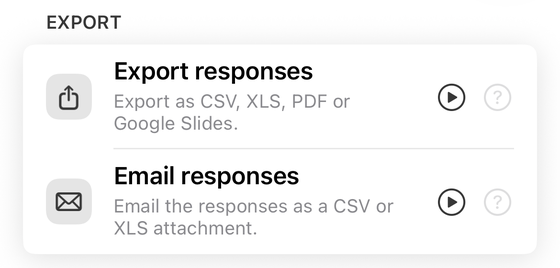
Forms+ is a native iPhone and iPad client for your real Google Forms, signed in to your own Google account. It does not change any of Google's limits — nothing can, they are server-side — but it does cover the parts that get awkward as a form grows: search across responses instead of paging through an individual view, CSV export and PDF summary reports from your phone, push notifications when new responses arrive, and reports you can pull without the Sheets link staying healthy.
Manage a busy form from your phone
Search, export and report on your real Google Forms responses — your account, your Drive, no migration.
Get Forms+ free on the App StoreFrequently asked questions
Is there a maximum number of responses a Google Form can accept?
No maximum is published by Google. Google's help page lists thresholds at which individual features stop working — 10,000, 50,000 and 100,000 responses — and says of them: “Your form continues to receive responses, which you can download in a CSV file.” That is not the same as a promise of unlimited capacity; it is simply that no hard cap is documented.
What happens after 50,000 responses?
The response summary can stop appearing. Google writes: “If you don't find the response summary, it can be because your form has more than 50,000 responses.” The form keeps collecting, and the CSV download still works — you lose the built-in charts and the aggregate view, not the data.
Why aren't my responses showing up in Google Sheets?
Above 100,000 responses, the link to Sheets can stop keeping up. Google writes: “If your form's responses aren't synced with Sheets, it can be because your form has more than 100,000 responses.” Below that number, a missing sync is usually a different problem — the sheet was never linked, or it was deleted or unlinked.
Is there a character limit on Google Forms answers?
None is published by Google. What Google does document is the limit you set yourself: a Length rule under response validation, where you “select Maximum or Minimum character count, and the number.” Google's own example is “Limit answers to 500 characters.” A platform-imposed ceiling on a paragraph answer is not documented anywhere in Google's help pages.
How many responses can a linked Google Sheet hold?
Google publishes a cell limit, not a row limit: “Up to 10 million cells or 18,278 columns (column ZZZ) for spreadsheets that are created in or converted to Google Sheets.” Divide 10 million by the number of columns in your response sheet to get the practical row ceiling — a 20-column form reaches it at roughly 500,000 responses, a 50-column form at roughly 200,000.